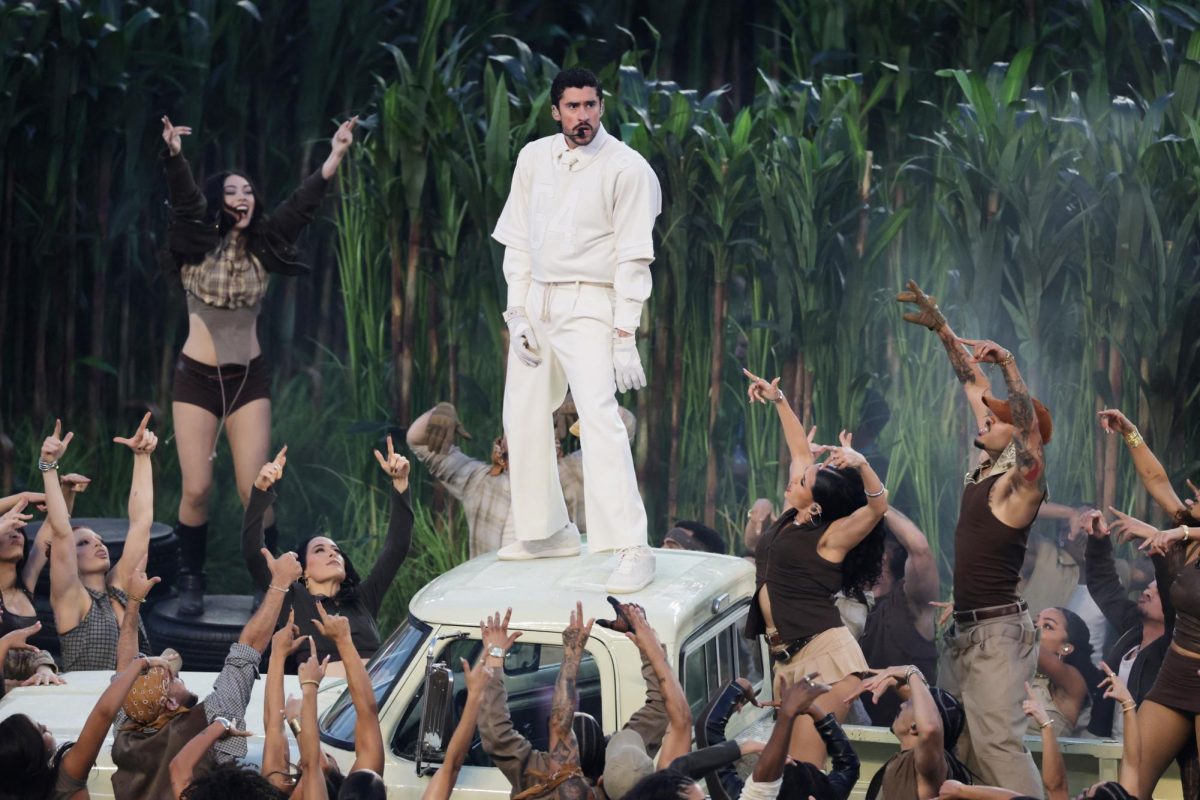
Bad Bunny made history at Super Bowl LX as the first Latin artist to perform the Super Bowl halftime show only in Spanish. He offered 13 minutes packed full of culture — not only Puerto Rican culture, but encompassing cultures from various Latin countries.
In his performance, he included hits from his newest album DeBÍ TiRAR MáS FOToS like “DtMF,” “NUEVAYoL,” and “BAILE INoLDIVABLE,” but also included songs from past albums like “Tití Me Preguntó” and “Yo Perreo Sola.” It also featured guest performances from Lady Gaga singing a salsa rendition of “Die With a Smile” and fellow Puerto Rican artist Ricky Martín singing “LO QUE LE PASÓ A HAWAii.”
“I loved it,” Burroughs Spanish Teacher Kayla Monk said. “I loved that if you knew nothing about politics or some of the issues in Puerto Rico, that you could get the overall vibe of family, community, culture, and love.”
Comparable to last year’s halftime show headlined by Kendrick Lamar, Bad Bunny’s performance was filled with political messaging with a main message of unity. Most notably, at the end of the performance, he brought out all the flags of North and South America and displayed a football that had “Together, we are America” written on it. Also displayed on a giant screen was the phrase “the only thing more powerful than hate is love,” echoing his message from the week prior at the Grammys that called for the removal of ICE.
“I think the message behind naming every Spanish-speaking country including the US, especially during this time, was incredibly heartfelt and important for it to be put on one of the biggest stages in the world,” said senior Savannah Fineg. “Not only did he promote love and acceptance of all people, but he wants unity, respect, and peace, and expresses that through his music.”
Bad Bunny also continued his message by calling for the independence of Puerto Rico. Raising the original pale-blue Puerto Rican flag, he was joined by Ricky Martín singing “LO QUE LE PASÓ A HAWAii,” a song urging Puerto Ricans to hold onto their culture so the disappearance of Hawaiian culture doesn’t repeat itself in Puerto Rico.
“I think the Bad Bunny Halftime show was very influential, especially with the different aspects that he put into his show,” said junior Estella Spurlock. “From the light-blue Puerto Rican flag to Ricky Martín’s statement about PR not turning into Hawaii, each aspect brought out the struggles of Puerto Rican people and how they continue to make life livable despite their struggles of being a US-controlled territory.”
This performance overall spoke to all Latinos, not just Puerto Ricans. As a Mexican-American, I saw pieces of my culture along with nostalgic experiences. In the wedding scene, I was able to see my own memories of parties that lasted till early morning full of family, dancing, and, most importantly, love. It was obvious to see that Bad Bunny cares deeply for not just his culture but the representation of all Latino cultures. He included major figures like Toñita Cay, the owner of a Puerto Rican social club in New York, and real small businesses, like Villa’s Tacos in Los Angeles, giving under-represented people a platform.
Through all the controversy and anticipation for the Halftime Show, Bad Bunny delivered a performance for the history books. As the first Latin artist to perform only in Spanish, he delivered a message of unity and love for everyone throughout the Americas.