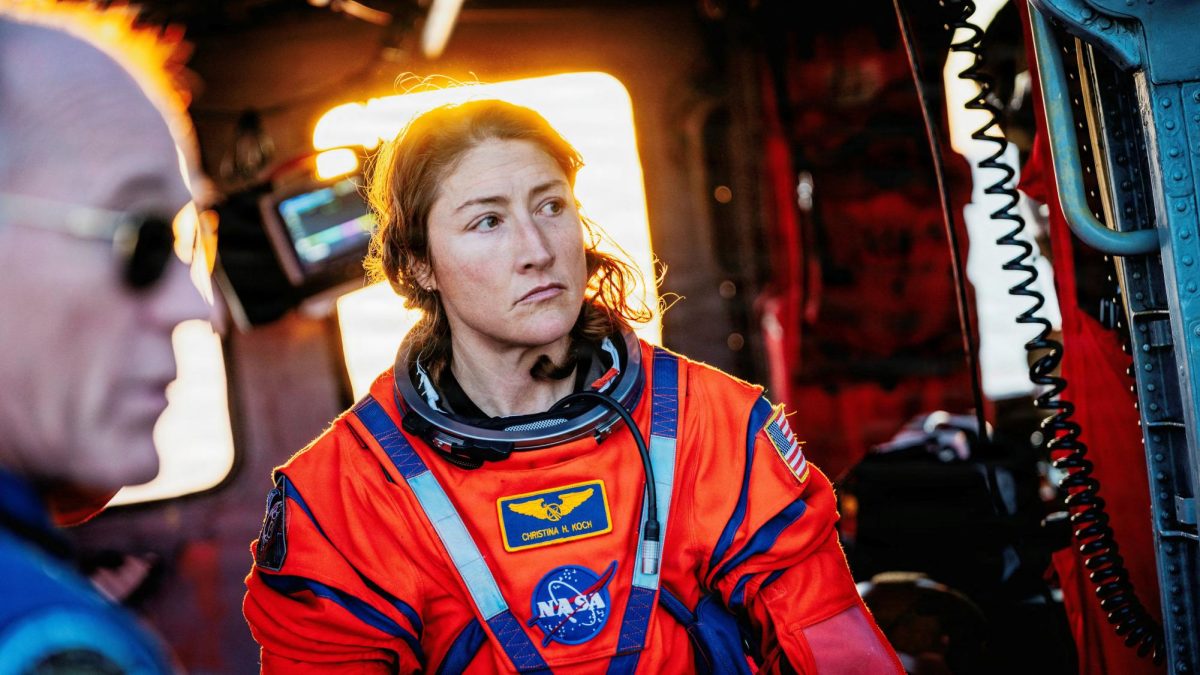
NASA’s Artemis II mission marks a major historic return to deep space, as astronauts prepare to travel around the Moon for the first time in over 50 years. Additionally, what makes the moment even more special is the social progress it marks. Christina Koch, who served as a mission specialist on the crew, is officially the first woman to have ever travelled around the Moon—an achievement many see as long overdue.
For much too long, space exploration has been predominantly dominated by men, especially during the vital, headline-grabbing moments. The Apollo missions, while groundbreaking, sent only male astronauts to the Moon. But through Artemis II, that has finally changed for the better. And it wasn’t just a publicity stunt where they included a woman only for diversity—Koch completely earned her seat.
Koch is no stranger to breaking boundaries. She holds the record for the longest single spaceflight by a woman (328 days), participated in the first all-female spacewalk, and is, of course, the first woman to travel around the Moon. Having her on the crew is something that makes sense; she’s already shown that she can easily handle all the physical and mental challenges of space, so now, she can be a part of something even bigger.
Some people will argue that having a woman on the crew is a symbolic move and that the mission is what actually matters. And while the mission is incredibly important, these people are missing the point about the power of representation. When our future generations watch the videos of this mission, they’re seeing what’s possible for their own lives. A young girl watching Koch could actually imagine herself doing the same thing, instead of wondering why only men seem to go to space.
And at the same time, while being incredibly important socially, Artemis II is a huge step forward for space exploration. NASA plans to have astronauts land on the Moon in 2027 aboard the Artemis IV. The reason is that NASA seeks to develop a long-term presence around the Moon, explore areas on the Moon that may contain water ice, and test technologies (such as the Gateway station) needed for future missions to Mars.
In the end, Artemis II is going to be remembered for a lot of reasons. But Christina Koch being on that spacecraft, where she’ll be traveling farther than any woman ever has, might be the part people connect with the most. It’s not just about space; it’s about how our future will be shaped.