Facing an ongoing teacher shortage, Sierra Sands Unified School District has expanded its recruiting efforts internationally—bringing in experienced educators from the Philippines through the J-1 Teacher Program.
Earlier this month, a delegation from Sierra Sands traveled to the Philippines to interview candidates and engage in a cultural exchange that included visiting local schools. The group included SSUSD Supt. Dr. April Moore, Asst. Supt. of Human Resources Bryan Auld, Executive Director of the Sierra Sands SELPA Amy Self, and Desert Area Teachers Association President Eileen Poole. This is the third year Sierra Sands has recruited candidates from the Philippines.
Why the Philippines? To Burroughs Teacher Poole, it makes sense.
“The US and the Philippines have a good relationship,” said Poole. “As part of his promise to return, General MacArthur sent American teachers to the Philippines to strengthen that country and help it become independent, so the idea of our two countries exchanging teachers is an old one that makes sense. Plus — and this is a biggie — English is spoken over there. They speak the same language we do. Finally, the Philippines makes it easy for their teachers to come here.”
The teachers joining the district are highly experienced — each with at least five years of classroom teaching and, in many cases, advanced degrees. They can work for up to five years here and re-apply after a two-year break.
Poole said that those hired are eager to learn and grow.
“Every one of the candidates we interviewed asked about training opportunities. They want to learn about our schools, our culture,” she said. “Just like all of us homegrown teachers, they want to improve their teaching practice.”
Auld said the J-1 program has been an important strategy for maintaining instructional quality amid a nationwide shortage of credentialed teachers, particularly in math, science and special education.
“We knew that several districts like ours, which are geographically isolated, had been recruiting internationally,” explained Auld. “After several years of filling Sierra Sands classrooms with long-term substitutes or emergency credentialed teachers, we decided to include the Philippines in our recruiting plan.”
He clarified that Sierra Sands continues to recruit locally. “Some mistakenly think the district only recruits in the Philippines. This is untrue. We continue to recruit throughout California. However, we no longer travel out of state to recruit, as the national shortage has dramatically decreased the number of out-of-state teachers we can attract to our community,” he said.
For international teachers, the program offers financial and professional benefits as well as a chance to exchange ideas between educational systems.
“Personnel who have traveled to the Philippines to recruit have engaged in the ‘cultural exchange’ component of the J-1 visa,” Auld said. “In other words, we have visited public schools in several different areas of the country to observe their school systems. There are many differences between the public school systems in the U.S. and the Philippines. Although there are private schools that those with the resources can send their children to, public schools in the Philippines do not appear to have sufficient funding. Teachers are required to provide nearly everything for their classroom other than the furniture and a 32-inch smart TV (this is the extent of the technology provided). There are no service providers (e.g., counselors, school psychologists, speech language pathologists, nurses, paraprofessionals, etc.). No custodians or maintenance workers are working at public schools. Custodial and maintenance is the responsibility of the teachers.”
Auld also noted that U.S. teaching salaries are significantly higher than those in the Philippines. “There are two financial incentives for working in the U.S.,” he said. “First, U.S. teachers make a considerably higher salary than what is paid in the Philippines. The second is the exchange rate. The currency in the Philippines is the peso. The current exchange rate is approximately 55 pesos to one U.S. dollar. Consequently, they can earn and send home a much better salary to their families. Many of our international teachers have left their young children and spouses behind in the Philippines to come to the U.S. to work. This is their sacrifice: to move to the other side of the world so that their children and families can have a better life.”
At the school level, the addition of international teachers has already made a difference.
“They have been a big help in having teachers who know how to teach, are qualified to teach, want to teach, and planned to teach for their occupation,” said Burroughs Principal Carrie Cope. Burroughs currently has three international teachers. She believes that the program has had benefits beyond staffing with qualified teachers who know the curriculum.
“I think it is good for our students to be exposed to people from different cultures,” she said. “The international teachers are sharing their culture with the students. It helps our students grow and learn.”
For the visiting educators, the J-1 program has opened doors.
“I saw it as an opportunity to share my culture and teaching practices while also learning new educational approaches, classroom technologies, and diverse strategies from American schools,” said BHS Special Education Teacher Rogene Rizare.
Rizare said the cultural exchange has been one of the best parts of the program.
“It allows us to broaden our global perspective, enhance our instructional methods, and build meaningful connections with educators and students from different backgrounds,” explained Rizare.
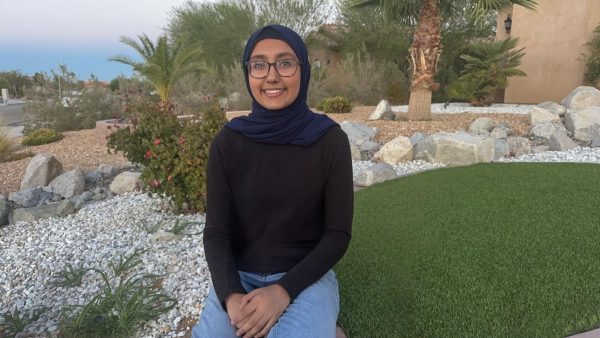
Another international teacher, Math Teacher Ariane Villanueva, said she is grateful for the experience.
“This program has given me the opportunity to grow both personally and professionally. I get to share my Filipino culture while learning from the diverse traditions and perspectives of my students and colleagues here in the U.S.,” she said.
Villanueva also spoke about adjusting to Ridgecrest life.
“Living in Ridgecrest has been an adjustment because the Philippines only has dry and rainy seasons, while here the desert climate is much drier and cooler in winter,” she said. “I’ve learned to dress in layers, stay hydrated, and enjoy the slower pace, which has made living and teaching here even more rewarding.”
To better support the growing number of international teachers, Auld said the district has hired three coordinators to assist them: Phoebe Camarines, Gemmalyn Navarro, and Lino Casas. Two of the coordinators, Camarines and Navarro, are actually second-year international teachers.
As Sierra Sands welcomes more international educators, district leaders and staff agree that the program’s success reaches far beyond solving a teacher shortage. The exchange has brought new energy, cultural awareness, and professional collaboration to local schools — enriching both the teachers who come to Ridgecrest and the students who learn from them.